All posts by Joseph Coulter

A Cosmic Courtship

If the kingdom of God is a wedding feast, it’s time to mail out the invitations.

A Cosmic Courtship

Right now, in the cosmos, a courtship is underway between two very unlikely lovers. One is the king of all there is. He is literally the King of the Cosmos. The other is a foolish and stubborn individual who is largely unaware of her lover’s interest, or even his existence. She is wandering around trying to make the best of her life in a confusing and dangerous world.

The king who seeks her love has provided a path, a gate, a portal, an invitation, leading directly to his side. He is ardently hoping that she will pass through that portal and step inside, so that he can woo her and win her love and take her to himself.

He is Jesus, the Son of God.

She is the human race. She is us.

The portal is the Christian gospel.

Opening the gospel, opening the invitation, is our prerogative. This cosmic courtship, like any other courtship, must begin with an initial introduction between the parties involved. Otherwise it remains merely a fantasy in the mind of one or the other, and never comes to anything. Once inside, however, the love affair begins in earnest.

The Christian gospel has enormous depth, and levels that humanity will never completely penetrate. But essentially it is a fascinating, emotional, passionate, and still developing love story between Jesus, the undisputed master of the universe, and us, the human race. Jesus is fervently (and almost obsessively) in love with us and has been pursuing us relentlessly for over two thousand years, even to the present day. In the gospel, the unfolding story of his courtship and love is revealed to us.

As a baby, Jesus astonished us. And as an adolescent, we thought him bright and clever. (See the second chapter of Luke’s gospel.) But when he came of age, around 30 years old, we somehow managed to catch his eye and win his heart. Filled with the spirit of love, he began showering us with marvelous and extraordinary gifts in the way of a suitor, and he began talking to us about his family and his father’s kingdom, of which he was heir. We listened, of course, with interest. As time went on he even began to speak of himself as “the bridegroom,” and us as his “pearl.” “A merchant,” he was overheard saying, “went out seeking beautiful pearls. When he found one pearl of great price, he sold all that he had and bought it!” He called us his “vineyard.” He called us his “little flock.” He called us his “treasure.”

Now all this sweet talk eventually found its way to the very top echelons of that cosmic realm, where Jesus’ father reigns as king and powerful beings rule in the heavens. The glorious and seraphic members of his father’s court were justifiably taken aback and puzzled at the news of this new love interest. They were quite familiar with Jesus, so there was understandably some shock and wonder and even dismay at this new turn of events. It might be helpful to picture the son of a great king traveling to a poor and remote settlement, and unexpectedly falling in love with an uneducated and very common peasant girl during the course of his visit. Naturally there were other contenders in this love game back home, brilliant, intelligent, well-groomed, and highly qualified, hoping to take their place at Jesus’ side when he became king.

Some of these splendid individuals were genuinely happy for him and wished him nothing but joy and happiness. Others, especially those with exaggerated self-importance, were disturbed and clearly envious, to the point of rage and hostility. One of them, known as Lucifer, decided to intervene directly and see what could be done. (A detailed account of this exchange can be found in the fourth chapter of Matthew’s gospel.) Finding Jesus alone, this gorgeous heavenly luminary showed up and made his pitch, “I can offer you food at the snap of your finger, risk, thrills, and excitement, and unbelievable popularity with the crowds! All you have to do is love me, and me alone!”

This was a tempting offer, to be sure, a wild fling with a dazzling escort. But Jesus thought way too much of his father and his family to run off with that floozy. Besides, he had already fallen in love with us, his treasure, his pearl! Though we were no great prize, we were his choice. He sent that arrogant highborn prince off empty handed with a curt dismissal, and that was that.

It wasn’t too long after this that our relationship with Jesus began to sour. For some unfathomable reason we began to grow alarmed and put up our defenses, questioning his every word and analyzing his motives. Our resistance only seemed to spur him on and strengthen his resolve to win our love. The second chapter of Mark’s gospel records the beginning stages of this angst, which only seemed to gain momentum as time went on.

Then one day Jesus met privately with his father’s legal team. Recorded in the ninth chapter of Mark and known as the “Transfiguration”, it was here that the facts were evidently all laid out on the table: We, the human race, as desirable as we might be, were in fact a convicted race of criminals and outlaws with a rap sheet that included thousands of years of treachery, deceit, murder, rape, war, pillage, carnage, and wholesale wickedness of every imaginable sort. The question begging to be answered was: How was Jesus going to reign over his father’s kingdom of justice, with us at his side as his future bride? Something drastic needed to be done to rectify our legal status, and it was going to be expensive and painful.

Immediately after this meeting we saw Jesus resolutely marching off to Jerusalem, the local seat of government, and declaring his intention of paying off our debt. We learn the rest of the story from the fourteenth and fifteenth chapters of Mark. Jesus was brutally crucified and put to death. But the gospel writers were careful to point out that he did it “for our sake.”

And now that the debt was paid and we were cleared of all charges at the price of his blood, Jesus was free to take his beloved bride to himself and carry her home, no?

The tragedy of the story, the cruel twist, is that the bride-to-be, on the eve of her wedding, declined his offer. Remember that poor peasant girl, the one that he fell in love with? That was us. That continues to be us. What were we thinking? We spurned him! If the truth were known, we hardly paid any attention at all to his offer. We couldn’t wait to forget all about him and get back to our normal wretched life.

There was, however, a spark of life in our eyes. It was not a lost cause by any means. “You have ravished my heart, my sister, my bride, with a single glance of your eyes. With a single bead of your necklace.” (Song of Solomon 4:9)

You could say that the early disciples’ response represented a “single glance” from the eye of the human race, toward Jesus. At any rate, we are told in the gospel that the King promptly prepared a wedding banquet for his son, and instructed his servants to send out the invitations to everyone. Everyone on earth, I might add. Everyone is invited! (Matthew 22:1-14)

On a personal note, I know I get confused as to my exact role in this cosmic event: Who, exactly, is the bride?

Am I the bride?

Am I a servant?

Am I a friend of the groom?

Am I a bridesmaid?

Am I an invited guest?

In the Old Testament, the people of Israel have a “spousal” relationship with God.

   ” Nations shall behold your vindication,
        and all the kings your glory;
    you shall be called by a new name
        pronounced by the mouth of the LORD.
    You shall be a glorious crown in the hand of the LORD,
        a royal diadem held by your God.
    No more shall people call you “Forsaken,”
        or your land “Desolate,”
    but you shall be called “My Delight,”
        and your land “Espoused.”
    For the LORD delights in you
        and makes your land his spouse.
    As a young man marries a virgin,
        your Builder shall marry you;
    and as a bridegroom rejoices in his bride
        so shall your God rejoice in you.” (Isaiah 62:1-5 )

Is the nation of Israel his bride?

In the New Testament, Paul identifies the church as the bride: “I have betrothed you to one husband, to present you as a pure virgin to Christ” 2 Corinthians 11:2.

Is the Church His bride?

In the Book of Revelations, the “new holy city Jerusalem comes down out of heaven from God, prepared as a bride adorned for her husband.” Revelation 21.

Is the city His bride?

In Catholic Tradition, every consecrated virgin considers herself, and is declared to be, the bride of Christ. There can certainly be no objection to that. These women have accepted His invitation with their entire being.

If I were to guess, however, with my limited knowledge of things, from a strictly human perspective, I would put my money on Mary Magdalene. Devoted and loyal friend and companion of the adult Jesus, singled out in many ways and present at all the crucial moments of his life. Yes, she could be the one!

But I’ve decided that it doesn’t really matter for the purpose of this discussion. We’ll have to wait for the actual wedding to see who the bride is.

Right now our instructions are clear: Send out the invitations! “Go out to all the world, and tell the good news!” (Mark 16:15)

The important thing, for all of us, is to invite as many people as possible, to be present at the wedding when it happens, and to come prepared to celebrate!

I might add that while a verbal invitation is perfectly acceptable, an official, formal, printed wedding invitation is much more likely to be taken seriously.

So let’s print up seven billion copies of the gospel of Jesus Christ(the wedding invitation), and send them out everywhere!

My next post, Political Baby Steps, describes some of my thoughts on Jesus’ political campaign.

Cultivating The Land

seeding machine

Mary Magdalene was the very first member of the human race to lay eyes on the resurrected Jesus. (John 20) Her mind was so distracted that she didn’t immediately recognize Him. But there was something about Him that caused her to conclude that HE WAS THE GARDENER…

I view Christian evangelism as an agricultural enterprise being conducted by Jesus, the owner of a large estate. The estate, in this case, consists of fields of people, the human race, spread out over the entire surface of the earth. Jesus introduced the concept of Christian evangelism this way: “A farmer went out to sow his seed.” (Luke 8:5) He further explained that “The seed is the word of God.” (Luke 8:11). I interpret that to mean the record of his words and actions while he was in the flesh, in other words, the gospel itself. The gospel is the seed that Jesus was talking about, and it needs to be planted in the mind of every man, woman, and child living on earth. “Go into the whole world and proclaim the gospel to every creature.” (Mark 16:15)

We don’t need to guess how Jesus went about developing his estate. He selected a group of laborers, trained them in his farming techniques, equipped them with the seed (the gospel), and sent them out to nearby fields to begin sowing.

After a certain period of time the harvest came, and Jesus the owner was able to show a small profit. Next year, using his profit, he sent out additional laborers to plant new fields, with the same result, thereby expanding year by year.

Fast forward, 2000 years. This farming project has been a colossal success and now covers 30% of the earth’s surface. (30% of the earth’s inhabitants currently identify as Christians). It is organized and robust, and it supports a massive and thriving farming community. Obviously, the owner is quite pleased with his progress.

Seeing his success, and being forward thinking, the owner (Jesus) is understandably eager to plant and develop the remaining 70% of his land. His instructions haven’t changed in the least:  “Go into the whole world and proclaim the gospel to every creature.” (Mark 16:15).

When a commercial farmer goes out to sow his seed these days, he generally uses a large tractor-driven seeding machine which sows seed by dropping them into straight furrows at precision rates and pre-determined depths. There is nothing hap-hazard about it. If he is sowing corn, he will cover every square foot of his field with corn seed, and expect the new plants to emerge within three weeks of planting. After about three months the ripe corn will be ready for harvest. Thanks to mechanized farming the world’s food supply has increased dramatically over the decades.

There are undoubtably many ways to proclaim the gospel in our world today, and as long as we are making an attempt, progress is certainly being made. But due to the economies of scale it may no longer be feasible to send out small teams of evangelists to increasingly hostile and far-flung lands to impart the gospel message. That model may have to give way to new large-scale industrial “farming” techniques. The same exact seed (the gospel) needs to be planted, but what new tools do we have at our disposal?

In our day and age, for the first time in human history, individual gospels can be mass-produced by a process known as print-on-demand. Quality copies of individual gospels (each approximately 60 pages long) can be mass-produced for mere pennies.

And, for the first time in human history, these small printed gospels can be distributed rapidly and intelligently by another new process known as “direct mail”. Direct mail is often used by advertisers or politicians to put a physical copy of their brochure into the hands of potential prospects. It is inexpensive, and studies have shown it to be almost 10 times as effective as digital marketing.

These new tools are increasingly available within vast areas of currently “un-planted” territory in every continent across the globe, the very countries we are trying to reach with the gospel, those very people who have never been approached, ever, with the message of Jesus. 70% of the earth’s population, over 5 billion individuals, fall into this category. Statistically, the average age of these people is 26 years old. Could these modern tools be put to use in the service of global Christian evangelism?

Large scale or regional gospel mailing programs could never be considered a replacement for the classic “neighbor-to-neighbor” evangelism that the church has always encouraged. If anything, the need and opportunity for one-on-one encounters would only increase if direct gospel mailing were ever implemented.

My son, who works as a groundskeeper at a local private school, was sitting with me one afternoon on my deck, admiring my lawn. He commented that while the lawn looked nice enough, it was almost entirely made up of weeds, with very little actual grass! Ouch! To remedy that, he suggested I get some high quality grass seed and spread it evenly across the entire lawn. This process, known as “over-seeding”, might take several applications, but eventually the new grass would choke out the weeds and my lawn would be both beautiful and healthy.

It is a well established fact, and almost every serious commentator looking at the current Catholic landscape would agree, that the “Lord’s Harvest” is looking rather thin these days, and the fields are rapidly being over-run by weeds. That is certainly the case in North America. I know this is a complicated and many-faceted problem. But perhaps the church might consider a program of “over-seeding” as an option, right here in the United States. The seed is the word of God, (Luke 8:11) and the church has four varieties of high-quality seed at its disposal:

  • The MARK variety. Perfect for a first application, also known as the “quick-start” variation.
  • The LUKE variety. Produces robust, healthy growth. Does well in full sun.
  • The MATTHEW variety. Deep rooted and fine textured.
  • The JOHN variety. Intense and everlasting.

Four successive applications of these marvelous seeds, carried out over the course of several years, might be all that’s needed to restore the church’s vitality and fill the barns with finest wheat.

In the United States, the US Postal service has a direct mail program known as EDDM, or Every Door Direct Mail. I have been experimenting with EDDM for the past several years as an efficient and economical way to spread the gospel to a widely diverse population within the state of New Jersey. As of this date I have mailed out over 5,000 copies of Mark’s gospel to households all over New Jersey. I have no way to measure the effectiveness of this process at present, but I am hopeful that at least some of the recipients will be curious enough to pick up the gospel and give it a read. Obviously I haven’t even scratched the surface here.  According to the 2020 census there are over 3.2 million individual residential households in New Jersey.  In fact there are more than  9,500 households located just within a three mile radius of my local parish church. 

I happen to be father of five grown children, and grandfather to a small but growing number of lovely grandchildren. This is my “domestic church”, over which I have some direct responsibility. My little church’s landscape is similar to that of the wider church, disturbingly over-run with weeds! To counter that I have embarked on a gospel seeding program. This year at Christmas I gave every family in my little church a copy of Mark’s gospel. Next Christmas they will be surprised to receive a copy of Luke’s gospel. The following year I have copies of Mathew’s gospel for them, and finally on the fourth Christmas they will all receive a copy of John’s Gospel! What they do with the gift is up to them. I have every reason to expect a good yield for my effort.

If spreading gospels through the mail ever became a thing, laborers, a.k.a. dependable and hard working postal employees, could begin sowing gospel seeds immediately through the use of Every Door Direct Mail. They would not require the customary long years of training needed in the past; no training in ministry, no theology, no psychology, no ordination, no investiture of any kind. Postal workers, by the very nature of their job, are responsible, accountable, judicious, and trustworthy. They have been trained to deliver the mail without judging its content or interfering with its purpose. They are amply paid and they depend on their jobs for their livelihood. They are the perfect people to carry out Christ’s wishes: “Go out to all the world and spread the good news.”

Those highly trained men and women currently on staff within the vast farming community  would have their hands full when the next harvest came in. The seed is just as potent as ever, and promises an abundant harvest, as always.

My next post, Mixing Metaphors , develops the farming metaphor a little more.

Return to Home

Mixing Metaphors

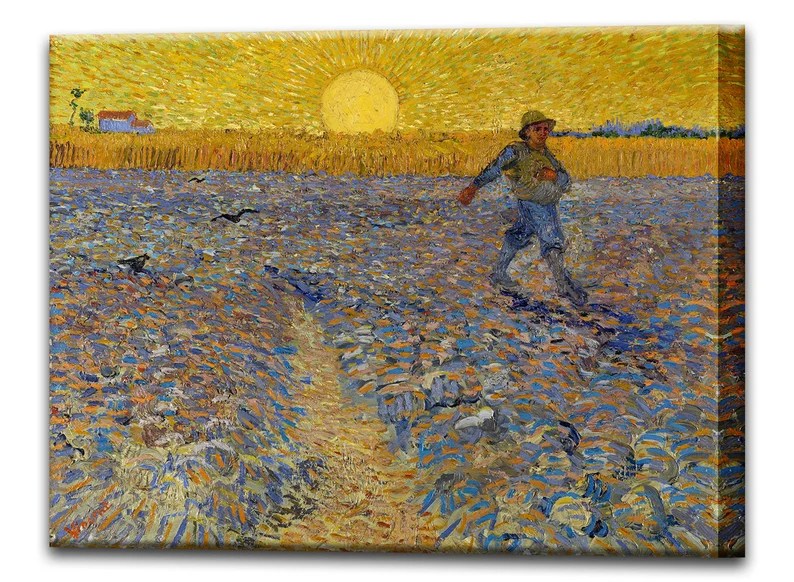
Van Gogh Sower“The seed that falls on good ground will yield a fruitful harvest.”


I am intrigued by Jesus’ many remarks, found in the gospels, concerning the topic of agriculture.

I am equally taken with the concept of treating Christian evangelism as if it was a political campaign, featuring Jesus as the dominant and exalted candidate for the highest office in the land, and his gospel as the perfect campaign brochure. These two ideas seem linked.

There are many parallels between Jesus’ treatment of farming, and our understanding of political campaigning.  Most Christians would agree that when Jesus spoke of seedtime and harvest, sowing and reaping, weeding, watering, and pruning, he was referring to what he saw as an organic process by which his kingdom would grow and spread to all the nations of the world.

Jesus, the master gardener, said, “Once there was a man who went out to sow seed…”(Luke 8:5).  I take that to mean the actual words that he himself spoke, as well as the record of his actions while he lived in Palestine, i.e. the Gospel. In other words, the Gospel itself is the seed he was talking about. (Is this too obvious?)

Seeds are plain and ordinary, right? You pick them up at the garden center in the spring and plant them in your garden. Or you re-seed the bare patches in your lawn. No big deal.

But some seeds are more valuable, and they come with a history. They are called heirloom or heritage seeds, and they have been developed over hundreds of years, perhaps by a single family who has guarded and propagated this particular variety because of its inherent value.

So for the purposes of this article, I want to compare the Christian Bible to a seed catalog:

  • The Old Testament as a record of the history and development of one particular seed.
  • The New Testament (Acts of the Apostles and Letters) as a “how-to” manual for planting and caring for this seed.
  • The Book of Revelation as an analogy to the full-grown plant.
  • The Four Gospels as the actual seeds that need to be planted.

One hundred percent of Christian literature, without exception, is about the seed, but it is not the seed. Apologetics, Christian history, Holy Encyclicals, the lives of the saints, instruction in ministry, books on how-to-live-the-Christian-life, conversion stories, exciting fiction, the coming apocalypse; these are all great and inspiring books, and thank God for them, but they are not the seed. (And nobody said they were.) This noble body of literature is entirely directed towards people who are intent on nourishing the seed that has already been planted in their minds.

Consider the factory worker in Flint, Michigan, who is trying hard to be a good Muslim. Or think about the computer programmer in Seattle who was told by her parents to avoid western philosophies like the plague. How about the successful businessman from South Philadelphia, who meets his family and friends regularly in the Hindu Temple? Christian literature finds no home within them. What bears repeating is that there are over 5 billion of these good people in the world, and they constitute seventy percent of the earth’s population. For them, Christianity is a non-subject. Their cultures preclude any real possibility of ever coming into contact with the gospel, either spoken or printed. There is an impenetrable spiritual barrier in place that not many humans can cross.

Not many can cross this divide, that is, with the notable exception of the humble postal worker, who can easily step over the barrier and plant a gospel seed as easily as dropping an envelope through the mail slot in the front door or into the mailbox at the curb.

The four gospels are the very seeds that Jesus came to deliver, and they were intended for planting. Sending any other Christian literature to our secular world is like sending pictures of corn to a farmer. He doesn’t need pictures. He needs corn seed.

I am of the belief that mailing out single, intact, copies of the gospel is a crucial step in the education and transformation of the world, one that could have a lasting impact on our civilization. I have created a small personal program to do just that. And I would argue that large-scale gospel mailing programs could be successfully carried out in almost every nation on earth where postal services are available. In my opinion nothing else will do. Gospel tracts won’t do. Great Christian literature won’t do. How-to books won’t do. Internet podcasts won’t do. I would like to be a sower of real seed, seed that will take root and grow.

There is a question looming in my mind: Is sending out copies of the gospel a waste of my time? I don’t really know the answer to that question, but I’ve decided to go ahead with my program despite my own doubts, based solely on some old scripture passages that I have admittedly interpreted to suit my own purposes:

  • “So shall my word be that goes out from my mouth; it shall not return to me empty, but it shall accomplish that which I purpose, and shall succeed in the thing for which I sent it.” (Isaiah 55:11)

This passage is most reassuring and would seem to indicate that my program cannot fail. Lord, help my unbelief!

  • The Parable of the Sower (Mark 4:3-9)

The Parable of the Sower is so important in the gospels that it is repeated six times (twice in Matthew, twice in Mark, and twice in Luke). In the story, Jesus throws his seed out indiscriminately and stands back to see what might happen. Some of the seed takes hold and produces prodigiously, while some of the seed does not fare so well. Interestingly, Jesus seems to expect at least 75% of the seed to germinate, while allowing that only about 25%  will mature (the seed that falls on good ground).

And paraphrasing some other encouraging words of Jesus:

  • “Don’t bother to weed.” (Matt. 13:24-30)
  • “Don’t fret over your crop. Just leave it alone.” (Mark 4:26-29)
  • “That tiny little seed you are planting will be the biggest crop in your field.” (Mark 4:30-32)

Finally, Jesus’ concept of farming includes the possibility for exponential growth. Jesus predicted that some of those seeds could produce as much as 30, or 60, or 100 fold return. Best to wait and see before getting carried away! But I am eager to observe the outcome of my small gospel-planting project. My hope is that at least some of those who read the actual gospel will modify their way of thinking about Jesus, and believe in the possibility of a world completely immersed in his divine and passionate love.

To mix my metaphors once again, I would like to see many people cast their vote in favor of Jesus, and cultivate his love in their hearts.

My next post, A Cosmic Courtship, describes why we are so honored to be  mailing out the gospel.

Return to Home

Political Baby Steps

babyanduniverse

3 – Political Baby Steps

I am a complete novice when it comes to politics and the process of running a political campaign. I have never been involved in politics at any level, with the exception of helping my friend become president of our senior class at college. Our main strategy at that time was to plaster campaign fliers on every tree and lamppost across campus. It actually worked surprisingly well.

Thinking I would test the concept of running a political campaign for Jesus, I printed up some business cards with His picture on the front, and my website on the back, and got myself into Times Square, New York City. My plan was to distribute the cards to random pedestrians, and assess their reactions. I discovered three things:

  • Not a single person would take a card from me, or even make eye contact.
  • When I placed the cards on public benches and tables, they were immediately removed and discarded by custodians working in the area.
  • If I placed a card on a table that was occupied, the reaction was often ridicule or outright hostility.

I somehow managed to place about 250 cards on public seating locations in Times Square before I lost my nerve and hurried home.

Over the next couple of months I got “hits” on my website from the following countries: United States, Brazil, Canada, India, Italy, Argentina, Portugal, Australia, Philippines, United Kingdom, Chile, Mexico, Albania, and Sri Lanka.

I won’t even try to correlate the hits on my website with the distribution of business cards, but I must say I was encouraged by the apparent interest in Jesus shown by people across the globe.

When I was 30 years old, I left rural Connecticut and went to live in a Catholic church in the heart of Newark, New Jersey. Joining a number of other zealous young men and women in a program of Christian renewal, we often fanned out across the inner city neighborhoods inviting people to our church. Although some of my new friends may have been effective evangelizers, in my case I believe the local residents of Newark tended to look on me with downright pity. The Lord, in his great wisdom and mercy, arranged for me to meet a lovely young woman and get married, before I could do any real damage in the missionary fields!

Subsequently, my wife and I served on several parish missions as part of a team that would travel up and down the east coast seeking to renew parish life. We would give our witness, lead the music, pray over people for healing, and try to answer people’s questions as best as we could. Cynics might say we were “preaching to the choir”. Evangelicals call it “refreshing the saints”. Pope John Paul II called it “providing ongoing catechesis for those who are ‘fervent in their faith'”.

But I never encountered a single person who was being exposed to Christianity for the first time.

Even now, many years later, I am still not convinced that I have ever been involved in actually spreading the gospel, in the sense of expanding the Kingdom of God.

In my mind, expanding the Kingdom must somehow involve breaking new ground. Every living thing has to grow. Farmers need new crops. Families need new babies. Hollywood needs new movies. Walmart needs new products.

Every political campaign needs new voters to successfully win an election. They can’t just rely on the party regulars to supply the necessary votes for a victory. They have to appeal to the general public in order to increase their voter base. I ask myself how modern political campaigns get their message out to the masses? One technique that is familiar to us is the use of mailing campaigns. Postcards and flyers arrive in the mail describing a candidate’s qualifications, (and the opponent’s shortcomings), in the hopes of educating the electorate. Sometimes these campaigns target specific people at specific addresses, but at other times they are simply addressed to “Local Postal Customer.”

Every Door Direct Mail, or EDDM, is a service of the U.S. Postal Service developed to make mass mailing both easy and inexpensive. No postage permit is required, and no mailing lists are needed. Using their mapping tool, I can hover over an area that I am interested in, select an entire postal route, (typically around 300 households) and arrange for my campaign literature to be delivered to the “local postal customer “at the low cost of $0.18 per mail piece.

Let me repeat that: I can deliver my campaign literature (in this case the Gospel of Mark) to an entire postal route of 300 households, for about $50.00 postage (plus the cost of the printed material). Since each household typically consists of at least 4 people, I will be effectively reaching 1200 souls with my candidate’s message every time I conduct an EDDM mailing to an individual postal route.

Unless I’m mistaken, delivering an up-beat message through the mail to prospective voters is probably the most efficient and successful tactic that a politician can employ to win votes during an election. Likewise, a short and pithy biography of the candidate (i.e. the gospel) may be just the ticket to a successful campaign. I’m certainly hoping that is the case in this most crucial of all elections.

My next post The Power To Govern explains why our campaign is so crucial.

Return to Home

The Power To Govern

Scan

“The Lord is King, the Most High over all the earth”

4 – The Power to Govern

Let me be perfectly clear: Jesus doesn’t need our permission or our votes or our approval to govern the earth.  He is already the King. He was born a King on Bethlehem’s plain. The government is upon His shoulders. All authority has been given to Him.

So why am I comparing Jesus’ glorious kingdom to some sleazy political campaign?  Those two entities seem like such polar opposites.

The thing is,  we live in a physical world. Our world is dirty and gritty and often sordid, and a great many of its inhabitants are dirty and gritty and downright nasty, not the least of which are some of our career politicians, and the folks that push their detestable agendas. Like it or not, politics is the process by which we decide who we’re going to listen to and follow. Politics decides , from a human perspective, who has the power to govern.

So hear me out:  Our country has recently been through a number of bruising presidential elections, and for better or for worse, the winner in each case clearly walked away with the power to govern. The loser was given no such power, and really had no recourse but to return to the private sector. You all know what I am talking about.

So winning an election isn’t incidental. When it comes to governing, at least in a democracy, winning an election is everything.

Throughout history, in our world, absolutely nothing ever got  done in the absence of a clearly defined leader or head of state. Sometimes a leader  comes  into power by conquering and subduing  a nation, and sometimes a long established monarchy is able to hold on to power.  But the best kind of rulers, in many cases, are the ones who have been intentionally chosen by the very people seeking to be governed. King David was a perfect example of this. (Read 2 Samuel 5: 1-5).

As Christians we know that Jesus Christ is High King of Heaven. He is King of Kings and Lord of Lords. He is the Beginning and the End, the Alpha and the Omega.

But on earth, sad to say, he only has about 30% of the vote.   And that is just not enough to rule on earth. We Christians want him to govern, and he wants to govern, but until he wins some sort of universal popular acclaim, he has to work behind the scenes in the private sector. (Of course, he could easily conquer and subdue the earth, but he doesn’t seem inclined that way.)

I believe that Jesus is fully aware of this reality. When he set up his special little kingdom among his tiny group of original followers, he basically told them to do two things:

  1. Live your lives as if I am your king. (Which I am!)
  2. Spread my gospel (which includes my governing principals) over the entire earth.

To me, that sounds a lot like a political party campaigning for its favorite candidate. I don’t mean to be crass, but why should we continue to lose ground when we could be gaining ground just as easily?

I don’t know too much about running a political campaign, but I know that one of the first things, and probably the most important thing, is to get the word out. Print up the campaign literature and pass it out everywhere, particularly where the candidate is not well known. Take his case directly to the people. Let them decide by a simple vote whether or not they want him as their leader.

This question constitutes the main theme of these essays: How is Jesus going to get seven billion people to come to him and ask him to be their ruler?

It is my small uninformed humble opinion that the world’s Christians should begin focusing more energy into printing and shipping individual copies of single gospels (possibly through the use of national postal services) to virtually every country on earth, especially to those countries where Christianity has no vital presence. I am not talking about gospel tracts, or how-to books. I am talking about printing the entire gospel of Mark, for instance. Or Luke or John or Matthew, printed in the language of the country of destination. These small booklets are no more than 50 or 60 pages in length and are easily read and understood by normal intelligent people.

For all I know such a mailing campaign is being carried out by lots of individuals and groups all over the place, in other countries and continents. I certainly hope so. I’ve made up my mind to join in the effort in my own small way.

I frequently find myself fretting about the current state of our world. The list of modern-day woes goes on and on: Global pandemic. Threat of nuclear war. Climate out of control. Fentanyl flooding our border. Civil unrest and violence in our cities. Schools indoctrinating our innocent children. Corrupt politicians running our world. Artificial Intelligence threatening to alter human life at its core.

Since I suddenly find myself in this increasingly hostile environment, with  my faith and my very existence being  constantly threatened, sending copies of the gospel to families across the state of New Jersey seems like a perfectly reasonable counter-measure.

Once again, I sometimes have a tendency to wring my hands in frustration and pray that Jesus will return real soon. My pastor, on the other hand, recently paraphrased the angels who showed up after Jesus ascended into heaven: The angels said, “Why are you standing around staring up into heaven? You have a job to do!”

“The gospel must first be published among all nations.”

Mark 13:10 King James Bible

Return to Home