Tag Archives: Jesus

Mixing Metaphors

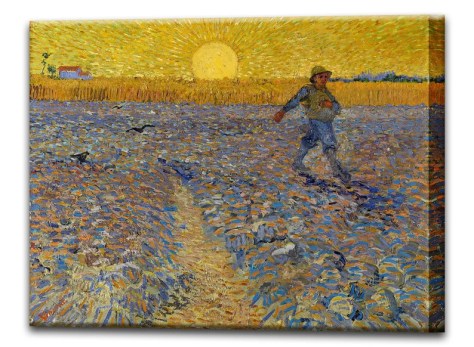
Van Gogh Sower“The seed that falls on good ground will yield a fruitful harvest.”

I am intrigued by Jesus’ many remarks, found in the gospels, concerning the topic of agriculture.

I am equally taken with the concept of treating Christian evangelism as if it was a political campaign, featuring Jesus as the dominant and exalted candidate for the highest office in the land, and his gospel as the perfect campaign brochure. These two ideas seem linked.

There are many parallels between Jesus’ treatment of farming, and our understanding of political campaigning.  Most Christians would agree that when Jesus spoke of seedtime and harvest, sowing and reaping, weeding, watering, and pruning, he was referring to what he saw as an organic process by which his kingdom would grow and spread to all the nations of the world.

Jesus, the master gardener, said, “Once there was a man who went out to sow seed…”(Luke 8:5).  I take that to mean the actual words that he himself spoke, as well as the record of his actions while he lived in Palestine, i.e. the Gospel. In other words, the Gospel itself is the seed he was talking about. (Is this too obvious?)

Seeds are plain and ordinary, right? You pick them up at the garden center in the spring and plant them in your garden. Or you re-seed the bare patches in your lawn. No big deal.

But some seeds are more valuable, and they come with a history. They are called heirloom or heritage seeds, and they have been developed over hundreds of years, perhaps by a single family who has guarded and propagated this particular variety because of its inherent value.

So for the purposes of this article, I want to compare the Christian Bible to a seed catalog:

  • The Old Testament as a record of the history and development of one particular seed.
  • The New Testament (Acts of the Apostles and Letters) as a “how-to” manual for planting and caring for this seed.
  • The Book of Revelation as an analogy to the full-grown plant.
  • The Four Gospels as the actual seeds that need to be planted.

One hundred percent of Christian literature, without exception, is about the seed, but it is not the seed. Apologetics, Christian history, Holy Encyclicals, the lives of the saints, instruction in ministry, books on how-to-live-the-Christian-life, conversion stories, exciting fiction, the coming apocalypse; these are all great and inspiring books, and thank God for them, but they are not the seed. (And nobody said they were.) This noble body of literature is entirely directed towards people who are intent on nourishing the seed that has already been planted in their minds.

Consider the factory worker in Flint, Michigan, who is trying hard to be a good Muslim. Or think about the computer programmer in Seattle who was told by her parents to avoid western philosophies like the plague. How about the successful businessman from South Philadelphia, who meets his family and friends regularly in the Hindu Temple? Christian literature finds no home within them. What bears repeating is that there are over 5 billion of these good people in the world, and they constitute seventy percent of the earth’s population. For them, Christianity is a non-subject. Their cultures preclude any real possibility of ever coming into contact with the gospel, either spoken or printed. There is an impenetrable spiritual barrier in place that not many humans can cross.

Not many can cross this divide, that is, with the notable exception of the humble postal worker, who can easily step over the barrier and plant a gospel seed as easily as dropping an envelope through the mail slot in the front door or into the mailbox at the curb.

The four gospels are the very seeds that Jesus came to deliver, and they were intended for planting. Sending any other Christian literature to our secular world is like sending pictures of corn to a farmer. He doesn’t need pictures. He needs corn seed.

I am of the belief that mailing out single, intact, copies of the gospel is a crucial step in the education and transformation of the world, one that could have a lasting impact on our civilization. I have created a small personal program to do just that. And I would argue that large-scale gospel mailing programs could be successfully carried out in almost every nation on earth where postal services are available. In my opinion nothing else will do. Gospel tracts won’t do. Great Christian literature won’t do. How-to books won’t do. Internet podcasts won’t do. I would like to be a sower of real seed, seed that will take root and grow.

There is a question looming in my mind: Is sending out copies of the gospel a waste of my time? I don’t really know the answer to that question, but I’ve decided to go ahead with my program despite my own doubts, based solely on some old scripture passages that I have admittedly interpreted to suit my own purposes:

  • “So shall my word be that goes out from my mouth; it shall not return to me empty, but it shall accomplish that which I purpose, and shall succeed in the thing for which I sent it.” (Isaiah 55:11)

This passage is most reassuring and would seem to indicate that my program cannot fail. Lord, help my unbelief!

  • The Parable of the Sower (Mark 4:3-9)

The Parable of the Sower is so important in the gospels that it is repeated six times (twice in Matthew, twice in Mark, and twice in Luke). In the story, Jesus throws his seed out indiscriminately and stands back to see what might happen. Some of the seed takes hold and produces prodigiously, while some of the seed does not fare so well. Interestingly, Jesus seems to expect at least 75% of the seed to germinate, while allowing that only about 25%  will mature (the seed that falls on good ground).

And paraphrasing some other encouraging words of Jesus:

  • “Don’t bother to weed.” (Matt. 13:24-30)
  • “Don’t fret over your crop. Just leave it alone.” (Mark 4:26-29)
  • “That tiny little seed you are planting will be the biggest crop in your field.” (Mark 4:30-32)

Finally, Jesus’ concept of farming includes the possibility for exponential growth. Jesus predicted that some of those seeds could produce as much as 30, or 60, or 100 fold return. Best to wait and see before getting carried away! But I am eager to observe the outcome of my small gospel-planting project. My hope is that at least some of those who read the actual gospel will modify their way of thinking about Jesus, and believe in the possibility of a world completely immersed in his divine and passionate love.

To mix my metaphors once again, I would like to see many people cast their vote in favor of Jesus, and cultivate his love in their hearts.

My next post, A Cosmic Courtship, describes why we are so honored to be  mailing out the gospel.

Return to Home

Political Baby Steps

babyanduniverse

3 – Political Baby Steps

I am a complete novice when it comes to politics and the process of running a political campaign. I have never been involved in politics at any level, with the exception of helping my friend become president of our senior class at college. Our main strategy at that time was to plaster campaign fliers on every tree and lamppost across campus. It actually worked surprisingly well.

Thinking I would test the concept of running a political campaign for Jesus, I printed up some business cards with His picture on the front, and my website on the back, and got myself into Times Square, New York City. My plan was to distribute the cards to random pedestrians, and assess their reactions. I discovered three things:

  • Not a single person would take a card from me, or even make eye contact.
  • When I placed the cards on public benches and tables, they were immediately removed and discarded by custodians working in the area.
  • If I placed a card on a table that was occupied, the reaction was often ridicule or outright hostility.

I somehow managed to place about 250 cards on public seating locations in Times Square before I lost my nerve and hurried home.

Over the next couple of months I got “hits” on my website from the following countries: United States, Brazil, Canada, India, Italy, Argentina, Portugal, Australia, Philippines, United Kingdom, Chile, Mexico, Albania, and Sri Lanka.

I won’t even try to correlate the hits on my website with the distribution of business cards, but I must say I was encouraged by the apparent interest in Jesus shown by people across the globe.

When I was 30 years old, I left rural Connecticut and went to live in a Catholic church in the heart of Newark, New Jersey. Joining a number of other zealous young men and women in a program of Christian renewal, we often fanned out across the inner city neighborhoods inviting people to our church. Although some of my new friends may have been effective evangelizers, in my case I believe the local residents of Newark tended to look on me with downright pity. The Lord, in his great wisdom and mercy, arranged for me to meet a lovely young woman and get married, before I could do any real damage in the missionary fields!

Subsequently, my wife and I served on several parish missions as part of a team that would travel up and down the east coast seeking to renew parish life. We would give our witness, lead the music, pray over people for healing, and try to answer people’s questions as best as we could. Cynics might say we were “preaching to the choir”. Evangelicals call it “refreshing the saints”. Pope John Paul II called it “providing ongoing catechesis for those who are ‘fervent in their faith'”.

But I never encountered a single person who was being exposed to Christianity for the first time.

Even now, many years later, I am still not convinced that I have ever been involved in actually spreading the gospel, in the sense of expanding the Kingdom of God.

In my mind, expanding the Kingdom must somehow involve breaking new ground. Every living thing has to grow. Farmers need new crops. Families need new babies. Hollywood needs new movies. Walmart needs new products.

Every political campaign needs new voters to successfully win an election. They can’t just rely on the party regulars to supply the necessary votes for a victory. They have to appeal to the general public in order to increase their voter base. I ask myself how modern political campaigns get their message out to the masses? One technique that is familiar to us is the use of mailing campaigns. Postcards and flyers arrive in the mail describing a candidate’s qualifications, (and the opponent’s shortcomings), in the hopes of educating the electorate. Sometimes these campaigns target specific people at specific addresses, but at other times they are simply addressed to “Local Postal Customer.”

Every Door Direct Mail, or EDDM, is a service of the U.S. Postal Service developed to make mass mailing both easy and inexpensive. No postage permit is required, and no mailing lists are needed. Using their mapping tool, I can hover over an area that I am interested in, select an entire postal route, (typically around 300 households) and arrange for my campaign literature to be delivered to the “local postal customer “at the low cost of $0.18 per mail piece.

Let me repeat that: I can deliver my campaign literature (in this case the Gospel of Mark) to an entire postal route of 300 households, for about $50.00 postage (plus the cost of the printed material). Since each household typically consists of at least 4 people, I will be effectively reaching 1200 souls with my candidate’s message every time I conduct an EDDM mailing to an individual postal route.

Unless I’m mistaken, delivering an up-beat message through the mail to prospective voters is probably the most efficient and successful tactic that a politician can employ to win votes during an election. Likewise, a short and pithy biography of the candidate (i.e. the gospel) may be just the ticket to a successful campaign. I’m certainly hoping that is the case in this most crucial of all elections.

My next post The Power To Govern explains why our campaign is so crucial.

Return to Home

The Power To Govern

Scan

“The Lord is King, the Most High over all the earth”

4 – The Power to Govern

Let me be perfectly clear: Jesus doesn’t need our permission or our votes or our approval to govern the earth.  He is already the King. He was born a King on Bethlehem’s plain. The government is upon His shoulders. All authority has been given to Him.

So why am I comparing Jesus’ glorious kingdom to some sleazy political campaign?  Those two entities seem like such polar opposites.

The thing is,  we live in a physical world. Our world is dirty and gritty and often sordid, and a great many of its inhabitants are dirty and gritty and downright nasty, not the least of which are some of our career politicians, and the folks that push their detestable agendas. Like it or not, politics is the process by which we decide who we’re going to listen to and follow. Politics decides , from a human perspective, who has the power to govern.

So hear me out:  Our country has recently been through a number of bruising presidential elections, and for better or for worse, the winner in each case clearly walked away with the power to govern. The loser was given no such power, and really had no recourse but to return to the private sector. You all know what I am talking about.

So winning an election isn’t incidental. When it comes to governing, at least in a democracy, winning an election is everything.

Throughout history, in our world, absolutely nothing ever got  done in the absence of a clearly defined leader or head of state. Sometimes a leader  comes  into power by conquering and subduing  a nation, and sometimes a long established monarchy is able to hold on to power.  But the best kind of rulers, in many cases, are the ones who have been intentionally chosen by the very people seeking to be governed. King David was a perfect example of this. (Read 2 Samuel 5: 1-5).

As Christians we know that Jesus Christ is High King of Heaven. He is King of Kings and Lord of Lords. He is the Beginning and the End, the Alpha and the Omega.

But on earth, sad to say, he only has about 30% of the vote.   And that is just not enough to rule on earth. We Christians want him to govern, and he wants to govern, but until he wins some sort of universal popular acclaim, he has to work behind the scenes in the private sector. (Of course, he could easily conquer and subdue the earth, but he doesn’t seem inclined that way.)

I believe that Jesus is fully aware of this reality. When he set up his special little kingdom among his tiny group of original followers, he basically told them to do two things:

  1. Live your lives as if I am your king. (Which I am!)
  2. Spread my gospel (which includes my governing principals) over the entire earth.

To me, that sounds a lot like a political party campaigning for its favorite candidate. I don’t mean to be crass, but why should we continue to lose ground when we could be gaining ground just as easily?

I don’t know too much about running a political campaign, but I know that one of the first things, and probably the most important thing, is to get the word out. Print up the campaign literature and pass it out everywhere, particularly where the candidate is not well known. Take his case directly to the people. Let them decide by a simple vote whether or not they want him as their leader.

This question constitutes the main theme of these essays: How is Jesus going to get seven billion people to come to him and ask him to be their ruler?

It is my small uninformed humble opinion that the world’s Christians should begin focusing more energy into printing and shipping individual copies of single gospels (possibly through the use of national postal services) to virtually every country on earth, especially to those countries where Christianity has no vital presence. I am not talking about gospel tracts, or how-to books. I am talking about printing the entire gospel of Mark, for instance. Or Luke or John or Matthew, printed in the language of the country of destination. These small booklets are no more than 50 or 60 pages in length and are easily read and understood by normal intelligent people.

For all I know such a mailing campaign is being carried out by lots of individuals and groups all over the place, in other countries and continents. I certainly hope so. I’ve made up my mind to join in the effort in my own small way.

I frequently find myself fretting about the current state of our world. The list of modern-day woes goes on and on: Global pandemic. Threat of nuclear war. Climate out of control. Fentanyl flooding our border. Civil unrest and violence in our cities. Schools indoctrinating our innocent children. Corrupt politicians running our world. Artificial Intelligence threatening to alter human life at its core.

Since I suddenly find myself in this increasingly hostile environment, with  my faith and my very existence being  constantly threatened, sending copies of the gospel to families across the state of New Jersey seems like a perfectly reasonable counter-measure.

Once again, I sometimes have a tendency to wring my hands in frustration and pray that Jesus will return real soon. My pastor, on the other hand, recently paraphrased the angels who showed up after Jesus ascended into heaven: The angels said, “Why are you standing around staring up into heaven? You have a job to do!”

“The gospel must first be published among all nations.”

Mark 13:10 King James Bible

Return to Home